

Practical self-defense training is built around a direct question: if a fight cannot be avoided, what should you do? The answer requires more than a collection of movements. Students need simple, reliable skills and the ability to respond decisively under pressure, create an opportunity to disengage, and get away from danger when possible.
Good self-defense training should also be accessible. You should not need previous martial arts experience, exceptional strength, or the fitness level of a competitive athlete before you begin. A responsible school meets students where they are and develops their awareness, technique, fitness, and confidence progressively.
The following seven principles explain how responsible self-defense training develops those abilities while helping beginners progress safely.
1. The training prepares you to act when a fight cannot be avoided
Awareness, avoidance, verbal boundaries, and de-escalation can help prevent some situations from becoming physical. CDK touches on these skills, but they are not the primary focus of training.
The primary focus is preparing students to respond when a fight cannot be avoided. They learn to protect themselves, act with purpose, create an opportunity to disengage, and get away from danger when possible.
Training should help students recognize when physical action has become necessary and apply straightforward techniques under stress. The goal is not to seek confrontation; it is to be capable of responding when prevention is no longer an option.
2. Techniques are simple enough to use under stress
A technique can look impressive during a demonstration and still be difficult to remember when someone is frightened, surprised, tired, or off balance. Practical self-defense should prioritize direct movements that can be learned progressively and repeated until they become more natural.
The goal is not to collect the largest number of techniques. It is to understand a smaller set of reliable principles and learn how to apply them in different situations. Training should account for differences in size, strength, experience, mobility, and fitness rather than assuming that every student moves in the same way.
A good instructor should be able to explain why a technique works, when it is appropriate, and what the student should do next. Simple does not mean careless or easy. It means the movement has been selected and taught with the reality of stress in mind.
3. Resistance is added only after beginners can train safely
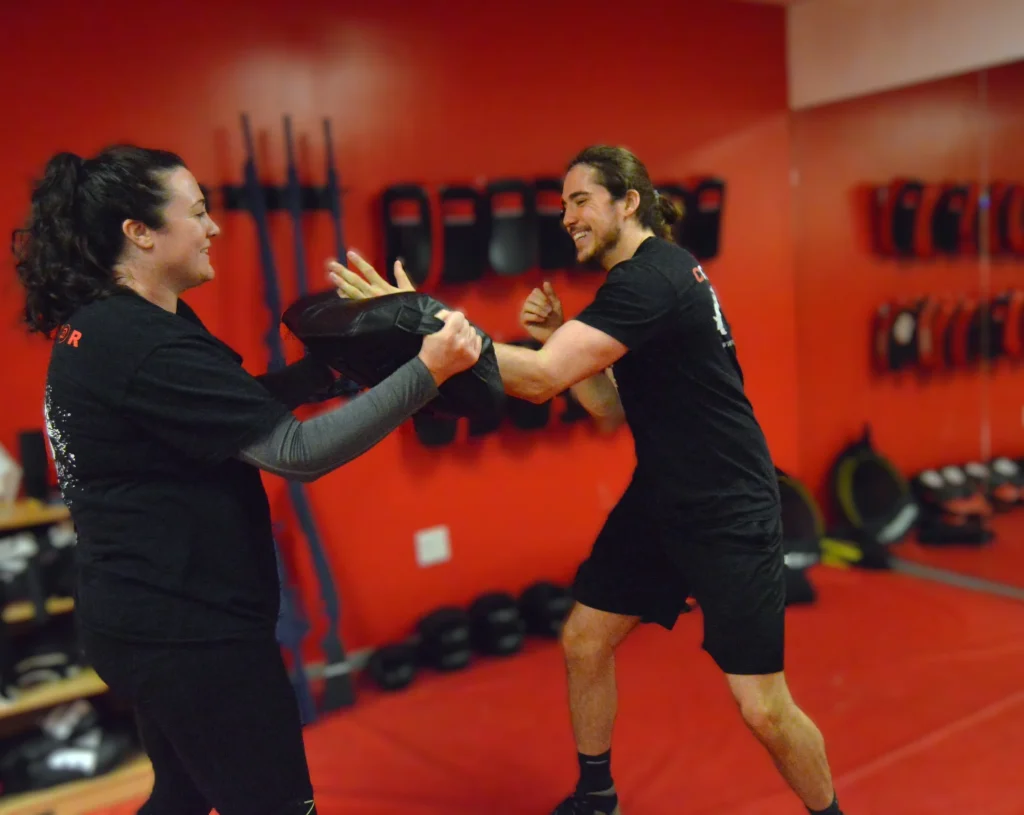
Beginners first practise techniques with a non-resistant training partner. This allows them to learn correct mechanics, positioning, and control while developing the ability to train safely with another person.
Once a student can perform a technique safely and consistently, instructors progressively add movement, changing angles, controlled resistance, and pressure. Appropriate protective equipment and close supervision help keep the training purposeful and controlled.
This progression protects both training partners. Realistic resistance matters, but it is introduced only after the student has learned to train safely.
4. The objective is to create safety, not win a contest
Sport and competition can develop excellent athletic and fighting skills, but real-world self-defense has a different objective. There may be no referee, agreed rules, equal weight classes, or clear beginning to the situation. The priority is to protect yourself, create an opportunity to disengage, and leave the danger when possible.
Training should therefore include decisions as well as techniques. Students should learn to consider distance, exits, multiple people, confined spaces, unexpected attacks, and the possibility that an object may be involved. The instructor should make clear that physical action is a last resort when safer options are unavailable.
A practical school does not encourage students to prove themselves. It teaches them to recognize when they need to act and when leaving is the better outcome.
5. Instructors can explain their qualifications and teaching approach
An instructor’s ability to perform a technique is not the same as the ability to teach it responsibly. Qualified instructors can explain their training background, current certifications, experience working with beginners, and the standards followed by their school.
Good instructors provide clear corrections without humiliating students. They adapt drills when someone has an injury or physical limitation, keep partner work controlled, and create an environment where questions are welcome. They should also be honest about what training can and cannot guarantee.
Consistent instruction and ongoing instructor development matter because most progress comes from the people students train with each week.
6. The program welcomes beginners and supports steady progress
Many people delay self-defense training because they believe they need to become fit first. A beginner-friendly program should help students improve their fitness as they learn, rather than treating fitness as an entry requirement.
The first classes should establish safe movement, basic striking mechanics, positioning, and simple defensive principles with a non-resistant training partner. Intensity and resistance can increase only after the student can work safely and with control. Instructors should also explain the equipment used and how progress is evaluated.
A supportive environment does not mean an easy one. Effective training should challenge students while giving them a realistic path to improve.
7. The school encourages consistent training instead of quick-fix promises
A short workshop can introduce important concepts and give participants useful starting points. It cannot reproduce the judgment, timing, conditioning, and familiarity that develop through consistent practice.
Responsible training does not promise to make anyone unstoppable or completely safe after only a few hours. No self-defense school can guarantee the outcome of a violent encounter. Good training improves preparation, expands options, and helps students respond more effectively, but it should be presented honestly.
A well-structured program provides a clear path from beginner fundamentals to more demanding scenarios. The value comes from repeated practice, constructive feedback, and gradually learning to perform while distracted or under pressure.
What responsible self-defense training avoids
- The school guarantees that its training will keep every student safe in any situation.
- Beginners are pressured into high-intensity drills before learning the fundamentals.
- Resistance is introduced before beginners can perform techniques safely and under control.
- The program focuses on looking impressive instead of teaching students how to respond effectively and create an opportunity to escape.
- Instructors cannot clearly explain their qualifications, safety procedures, or teaching progression.
- The culture rewards aggression, humiliation, or proving toughness at another student’s expense.
What practical self-defense training looks like at Krav Maga CDK
Krav Maga CDK teaches self-defense as preparation for real-world situations rather than competition. Training prioritizes straightforward techniques, partner practice, fitness, and reality-based drills that prepare students to respond when a fight cannot be avoided and create an opportunity to get away from danger. Awareness and avoidance are included as supporting skills.
Classes welcome beginners and experienced students, with instructors helping each person progress from basic movements to more demanding applications. CDK’s published approach emphasizes practical skills, supportive coaching, and training that can be used by people with different abilities and fitness levels.
Before enrollment, prospective students speak with the CDK team about their goals and program options. Once training begins, instructors introduce the fundamentals with a non-resistant training partner and add resistance only after the student can train safely and with control.
Book a free consultation and find the right CDK class for your goals.
Frequently asked questions
Do I need previous experience before starting self-defense classes?
No. A beginner-friendly program should teach the fundamentals progressively and explain how each drill develops. Previous martial arts or athletic experience can help, but it should not be required.
Do I need to get fit before joining?
You should not need to reach a particular fitness level before beginning. Training can improve strength, endurance, coordination, and confidence over time. Tell the instructor about injuries or limitations so the training can be adapted appropriately.
What is the difference between self-defense and competitive martial arts?
Competitive martial arts operate within rules, defined formats, and controlled environments. Self-defense prepares students for unexpected situations without agreed rules. Its primary purpose is to help them act when danger cannot be avoided, create space, and get away when possible. Awareness and avoidance are also discussed, but the objective and training context are different.
Is one self-defense workshop enough?
A workshop can introduce useful concepts and techniques, but consistent training is needed to develop timing, judgment, conditioning, and the ability to respond under pressure.
How often should I train?
The right frequency depends on your schedule, goals, recovery, and the school’s program. Consistency matters more than occasional bursts of intense training. Ask the instructor to recommend a realistic starting schedule.